So, I proposed a piece for this Literary Journal I have been a part of for years, a decade or more. I’m in it with my poetry, reviews, creative non-fiction, fiction, more.
I’m troubled by the people around me, those in academia, the arts, or literary circles. Truly, troubled, that they are not going deep into their minds about the swirling world they are around, and not just nature, where most of the works in the journal intersect with, or at least that was the case for years.
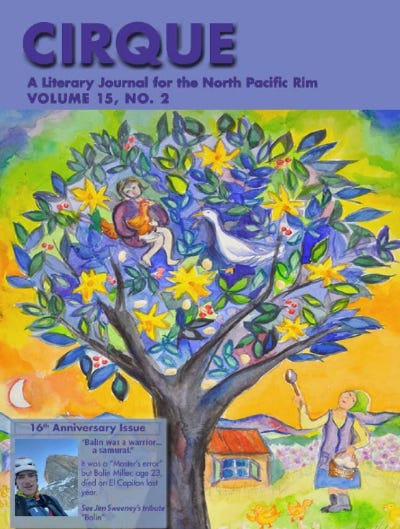
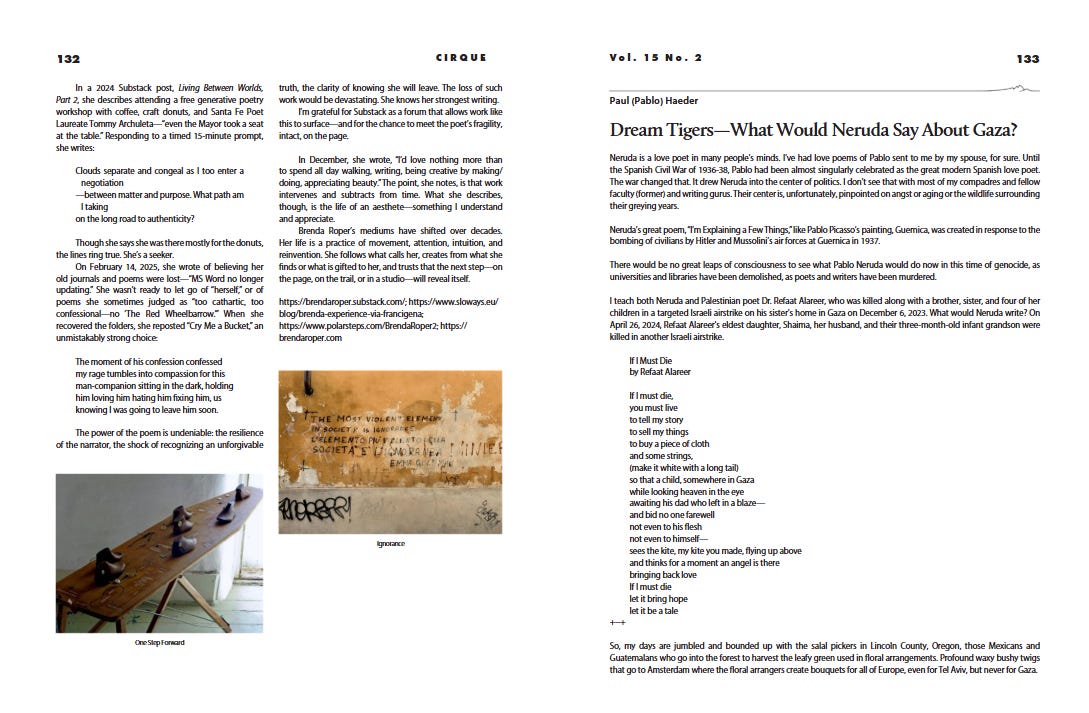
Go through it, and you’ll find the piece below starting on Page 132.
Here’s what Google says:
Primary factors driving this silence include:
- Institutional Censorship: Writers have faced retracted speaking invitations, cancelled fellowships, and editorial interference for publicly expressing solidarity with Palestinians. Prominent literary groups—such as PEN America and the Poetry Foundation—have faced massive boycotts from thousands of writers who accused these organizations of suppressing pro-Palestinian voices.
- Fear of Backlash: The polarized public discourse means that taking a firm stance often invites targeted smear campaigns, doxxing, or coordinated book-review bombing (which affects both pro-Palestinian writers and outspoken Jewish/Israeli authors).
- Editorial Hesitancy: Many publishing houses and literary magazines have avoided publishing pieces focused on the humanitarian crisis in Gaza to evade internal division, donor fallout, or public controversy.
To pressure authors to remain silent about institutional response to war in order to be eligible for prestigious literary prizes is not only ironic — PEN America’s mission, for instance, is to protect freedom of expression — but sinister. A culture that demands certain political allegiances from its writers and artists at the risk of losing career opportunities is one that is antithetical to democratic values, and harkens back to the McCarthy-era Hollywood blacklist that barred writers from employment on suspicions of “subversive” and “un-American” leanings.
“Palestine’s poets, scholars, novelists and journalists and essayists have risked everything, including their lives and the lives of their families, to share their words with the world,” the letter reads in part. “Yet PEN America appears unwilling to stand with them firmly against the powers that have oppressed and dispossessed them for the last 75 years.”
When writer and disability justice activist Alice Wong received a MacArthur Fellowship earlier this month, she shared a statement about accepting it “amidst the genocide happening in Gaza.” The backlash was swift, with a deluge of posts on X attacking Wong’s character and accusing her of antisemitism.
This conflation of opposition to Israel’s military action with hatred of Jewish people is only one part of a broader wave of political and social repression that is attempting to silence writers speaking out against the war. In the past month alone, authors who have criticized Israel’s ongoing bombardment of Gaza — which is funded largely by the U.S. — have been labeled extremists, been suspended and fired from faculty jobs, and targets of defamation and harassment.
I had my own recent experience with the latter following an incident with the New York State Writers Institute’s Albany Book Festival. I reached out privately to the festival organizers in support of a fellow author, Aisha Abdel Gawad, expressing concern about the public rhetoric of the moderator with whom we were to share a panel. In social media posts and published articles, the moderator mocked people who advocate for a ceasefire by calling them “terror apologists” and other names. Such rhetoric seemed disturbing in its mischaracterization of those mourning the loss of life, including Palestinian lives. In response, the assistant director of the Writers Institute emailed the moderator calling our concerns “crazy,” going so far as to fabricate a story that I refused “to be on a panel with a ‘Zionist,’” a message that was then made public. This resulted in death and rape threats, harassing messages and the loss of professional opportunities for me and Abdel Gawad.
To set the record straight, I neither refused to be on the panel nor used the word “Zionist,” but this clarification, while necessary, is not the point. The implication is that vitriol directed at those opposing war and genocide is acceptable; objecting to such vitriol is not.
*****
So, while I am MUCH more vociferous of how deeply sick the Jewish People of Israel and those who support it are, how unafraid I am of the consequences of calling a spade a spade — The Illegitimate Jewish State of Terror, Rape, Murder, DistortionGenocide — I have treaded somewhat lightly here, challenging myself to consider who Neruda was and what he might be saying and doing today, if around, alive, in his youth or in his prime.
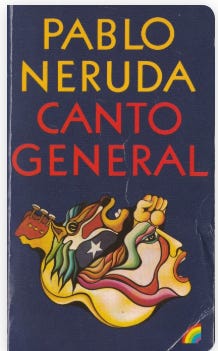
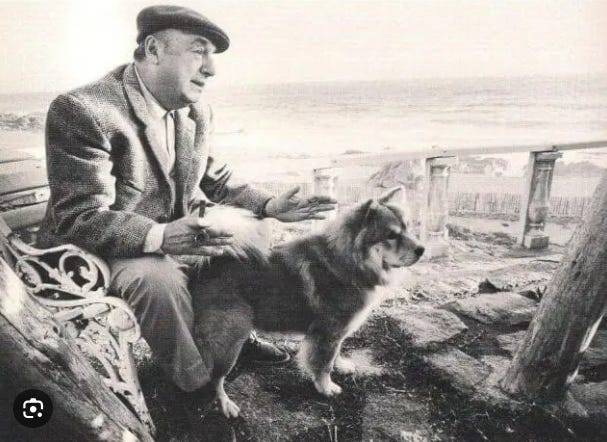
Neruda was a kind of King Midas. Everything he touched turned to poetry, says Gabriel García Márquez, who also considers the Chilean Nobel laureate “the greatest poet of the twentieth century, in any language.” [The Fragrance of Guava, 1983]. The Canto General, thought by many of Neruda’s most prominent critics to be the poet’s masterpiece, is the stunning epic of an entire continent and its people. The Canto speaks of the destiny of Latin American peoples and the life of the poet himself. Without question, this is one of the most important and powerful long poems written in the modern period.
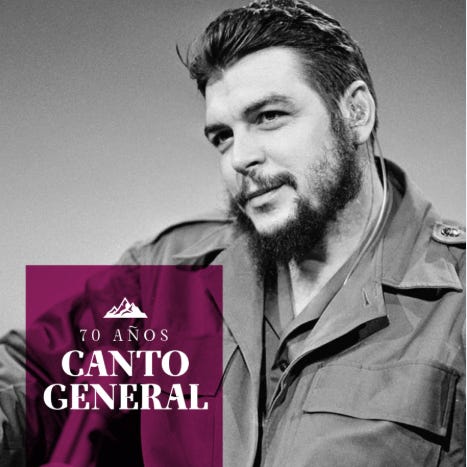
Canto General: An epic, sweeping historical and political masterpiece that chronicles the history of the Americas.
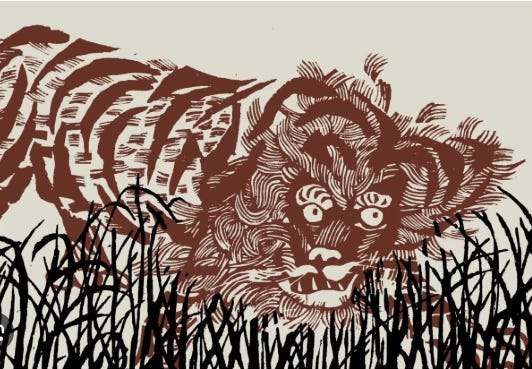
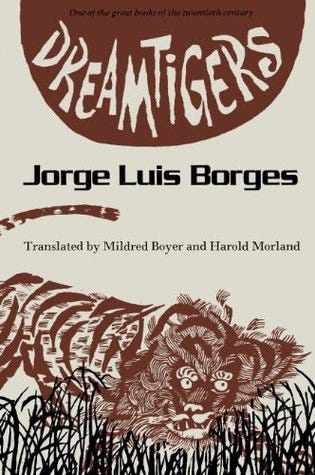
Dream Tigers: What Would Pablo Neruda Say About Gaza?
by Paul (Pablo) Haeder
Neruda is a love poet in many people’s minds. I’ve had love poems of Pablo sent to me by my spouse, for sure. Until the Spanish Civil War of 1936-38, Pablo had been almost singularly celebrated as the great modern Spanish love poet. The war changed that. It drew Neruda into the center of politics. I don’t see that with most of my compadres and fellow faculty (former) and writing gurus. Their center is, unfortunately, pinpointed on angst or aging or the wildlife surrounding their greying years.
Neruda’s great poem, “I’m Explaining a Few Things,” like Pablo Picasso’s painting, Guernica, was created in response to the bombing of civilians by Hitler and Mussolini’s air forces at Guernica in 1937.
There would be no great leaps of consciousness to see what Pablo Neruda would do now in this time of genocide, as universities and libraries have been demolished, as poets and writers have been murdered.
I teach both Neruda and Palestinian poet Dr. Refaat Alareer, who was killed along with a brother, sister, and four of her children in a targeted Israeli airstrike on his sister’s home in Gaza on December 6, 2023. What would Neruda write? On April 26, 2024, Refaat Alareer’s eldest daughter, Shaima, her husband, and their three-month-old infant grandson were killed in another Israeli airstrike.
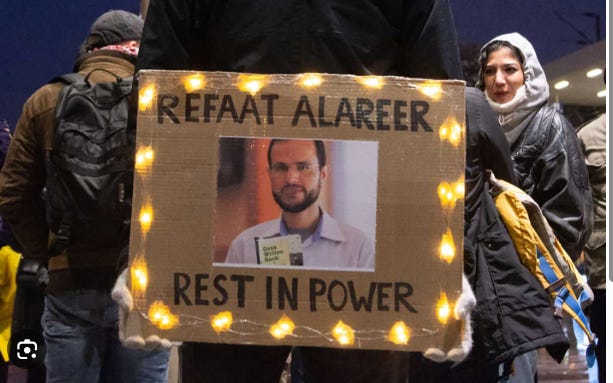
by Refaat Alareer
If I must die,
you must live
to tell my story
to sell my things
to buy a piece of cloth
and some strings,
(make it white with a long tail)
so that a child, somewhere in Gaza
while looking heaven in the eye
awaiting his dad who left in a blaze—
and bid no one farewell
not even to his flesh
not even to himself—
sees the kite, my kite you made, flying up above
and thinks for a moment an angel is there
bringing back love
If I must die
let it bring hope
let it be a tale
*****
So, my days are jumbled and bounded up with the salal pickers in Lincoln County, Oregon, those Mexicans and Guatemalans who go into the forest to harvest the leafy green used in floral arrangements. Profound waxy bushy twigs that go to Amsterdam where the floral arrangers create bouquets for all of Europe, even for Tel Aviv, but never for Gaza.
I have a radio show, and I have plenty of amazing radical guests on talking without fear against the regimes of death and destruction that define the Nakba perpetrators and the countless Western countries who have propped up that death-producing country.
Ahh, Neruda, our true revolutionary poet? After he worked to get Gabriel González Videla elected as Chile’s president on a radical left platform, González Videla did a one-eighty degree and launched a campaign of repression that included roundups of leftists and labor leaders. The violent repression of workers’ strikes added to this thug’s infamy. In true capitalist boom and bust orchestration, as copper prices plummeted after World War II, the Harry Truman administration (CIA, bankers) convinced González Videla that he would need the United States’ economic help and that war between the US and Russia was looming. This prodded González Videla to ban communism in Chile.
In exile in Paris and across several continents, communist Neruda wasn’t safe; he was surveilled wherever he went and detained. According to historians and poets alike, Neruda’s saga marks one of the 20th century’s greatest literary chase scenes, and the Cold War’s first global manhunt. “It wasn’t a hunt for a nuclear engineer, a spy, or even a dissident journalist but for a poet—a poet!—whose love poetry had won him acclaim and book sales around the world, and later earned the 1971 Nobel Prize.” from Joel Whitney’s “On the Run.”
When he was in Paris in 1949 to attend the First World Congress of Partisans for Peace, the news traveled back to Gonzalez Videla who called it “a fake news story.”
That canard is repeated by Netanyahu and all the squirming rats on the sinking mainstream media ship (stenographers of Zionist lies) about all propaganda (hasbara) spewed by Israel about Hamas or denying the 600,000 murdered souls in Palestine.
Maybe Neruda would pal around with Chris Hedges or gain an audience with Francesca Albanese. Certainly, Ralph Nader would be getting Pablo on his radio show:
“It makes a difference in driving the greater intensity of political, diplomatic, and civic pressures to have a count of 600,000 rather than 67,000 or 200,000 children rather than 20,000 children murdered.”
Neruda and Ralph would parse the war on Gaza with deep passion and knowledge.
Which stage would Neruda speak from if he were around today? Which of the following epigrams would he jump onto in agreement?
‘It is forbidden to kill: therefore, all murderers are punished unless they kill in large numbers and to the sound of trumpets.‘ – Voltaire (his 1765 work Questions sur les miracles)
‘I don’t know of any army that does more than an Israeli army does to avoid civilian casualties. But incidental and unintended casualties accompany every war.‘ — Benjamin Netanyahu (May 2026 statement, a March 2024 interview Chris Reason of Channel 7)
‘The right number of civilian casualties is zero.‘ — John Kirby, former US National Security Council spokesperson (NPR’s Scott Detrow spoke with John Kirby, President Biden’s spokesman on the National Security Council, about the U.S. role in the war between Israel and Gaza)
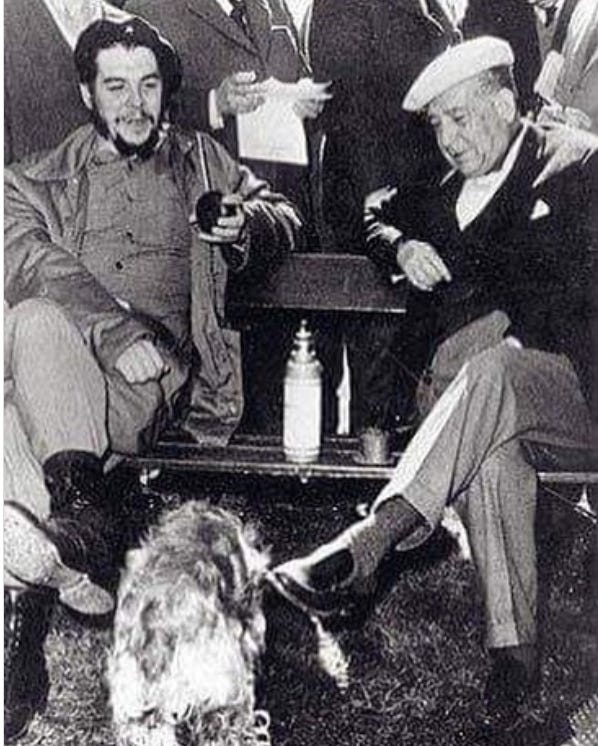
Does anyone teach Che-Castro and the glorious Cuban Revolution in schools anymore, as we now see the history of Palestine is forbidden in colleges throughout the land?
According to his compatriots, Che bought a cheap notebook on a trip to Tanzania in 1963 and would regularly kickback, often up a tree, to write in it. The publishing house Planeta has refused to say how it obtained this green notebook but said that it spent two years verifying its authenticity before publishing.
“It is a very intimate anthology loaded with political poems and poems dealing with emotions, feelings. This adds another element to the myth of Che,” says Paco Ignacio.
“When Che was captured, the military searched his bag and found two notebooks: one containing secret codes to communicate with Havana and the green notepad,” says Mexican writer and Guevara biographer Ignacio, who wrote the preface to the book.
What did Neruda mean to Che? Among the 69 poems in this little green journal are some by Pablo Neruda, one of the greatest Spanish-language poets of the 20th century, Cuban Nicolas Guillen and Peruvian Cesar Vallejo, who was one of the century’s great poetic innovators.
“The poet’s heart is, like all hearts, an unending artichoke, but in it there are not only leaves of flesh and bone women, of true loves and persistent dreams, but also of all the temptations of life, as well as of vanity. There is no true poet without vanity, no more than there are great ones unpublished. Therefore, I shall be picking out the leaves of vanity for you and me to consume, since it has been asked of me. I hope that it is for one of the last times and that all the rest, the other leaves I pick from my heart, will be a pure product, vegetable or celestial or terrestrial nourishment—poetry.” – Neruda
Like Palestinians, Neruda was displaced. This poem, while being exiled from Chile and in hiding throughout South America, speaks volumes:
I left my country
I crossed the cordillera on horseback.
A petty tyrant, a fast dancer sold
my homeland metal and minerals and all
and filled with walls and prisons
dawn’s domain.
I left through throats clawed
by nature, galloping
beneath the silence of a dark grove,
dovecotes of a sudden hurled out of
snowdrifts, frozen feathers,
a purity of power:
and quickly land and trees
became harsh foes and scars,
…
**Pablo Neruda ©1954
Heirs of Pablo Neruda and Fundación Pablo Neruda ©1999
Trans. Michael Straus ©2016
*****
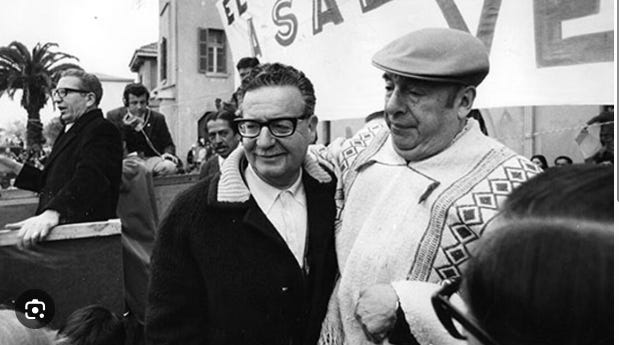
Oh, those terrible CIA-invoked coups, against his friend and socialist and democratically- elected president of Chile, Salvador Allende:
You are going to ask: and where are the lilacs?
and the poppy-petalled metaphysics ?
and the rain repeatedly spattering
its words and drilling them full
of apertures and birds?’
I’ll tell you all the news.
I lived in a suburb,
a suburb of Madrid, with bells,
and clocks and trees.
From there you could look out
Over Castille’s dry face:
a leather ocean.
My house was called
the house of flowers, because in every cranny
geraniums burst: it was
a good-looking house
with its dogs and children.
Remember, Raúl?
Eh, Rafael?
Federico, do you remember
from under the ground
where the light of June drowned flowers in your mouth?
…
Face to face with you I have seen the blood
of Spain tower like a tide
to drown you in one wave
of pride and knives!
Treacherous
generals:
see my dead house,
look at broken Spain:
from every house burning metal flows
instead of flowers,
from every socket of Spain
Spain emerges
and from every dead child a rifle with eyes,
and from every crime bullets are bom
which will one day find
the bull’s eye of your hearts.
And you will ask: why doesn’t his poetry
speak of dreams and leaves
and the great volcanoes of his native land?
…
© Translation: 1970, Nathaniel Tarn
From: Pablo Neruda Selected Poems: A Bilingual Edition
Publisher: Houghton Mifflin / Seymour Lawrence, Boston, 1970
“…and the blood of children ran through the streets….” Change the words to evoke the same blood in the streets of Gaza!
Come touch the blood on the streets, this invitation, but now, in Gaza, the West Bank, all of it, torn up and immolated by Israel supported by and with the warlords of finance and military hardware. There have been journalists in the hundreds targeted and murdered, bulldozed by US-made E-9 Caterpillars. Doctors and nurses with stethoscopes sniped and KIA-ed. All those tents, hospitals and ambulances, bombed and burned by the Occupying Forces of this “state”?
Neruda was always for resistance and against occupation and despotism.
The quote, “You can cut all the flowers, but you cannot keep spring from coming” is one of Neruda’s most frequently cited phrases in the context of political struggle.
- During the Arab Spring, the quote was spray-painted as graffiti on the streets of Cairo in Arabic, serving as an emblem of the revolution.
- During UN discussions in 2025 regarding the conflict, the Permanent Observer for the State of Palestine referred to the quote while describing Palestinian resilience. The quote is a testament to the hope for an independent Palestinian state.
يمكنك قطع جميع الزهور ولكن لا يمكنك منع الربيع من القدوم
The question for me after decades of writing, workshopping and teaching is how can a fiction writer, specifically a poet, stay cloistered during political upheaval and human rights abuses like we have seen, or at least those I have seen, in my lifetime?
I take care of the dispossessed, too, adults (and a kiddo, now) with developmental and behavioral disabilities. When need be, I even help with toileting, and so, the man with a plan, this communist who ran into Mexico over the borderline in the Huachuca Mountains at age fifteen while tracking a pack of javelinas, is the same man, now, ensconced in the revolution of Neruda, Garcia Marquez, Vallejo, et al.
Poetics and Robert Bly. Working the magic of words from William Stafford. I had his son, Kim Safford, on my radio show as a benediction to the Palestinian cause. Here, he read this short poem on my show, Finding Fringe, KYAQ.org, 91.7 FM:
Gauze
No one knows for sure if gauze comes
from Gaza, that place of nimble-fingered
weavers in early days who from silk or cotton
made fabric so fine, so friendly to the skin
it was forbidden by holy orders, but loved
all the same, worn in secret under what
could be seen, and long so essential for
dressing wounds it remains what doctors
reach for, after the shelling, after whole
families brought their fallen, working even
in the dark, even on the floor, while soldiers
stalk the ward, the surgeon’s hand groping
to staunch blood beating from a broken child.
*****
Kim tells me he lost Jewish friends, old friends indeed, because of this poem. These are those times Neruda would be spieling on, for sure.
Indeed, everything changes but stays the same in that dream, those tigers of Borges’ dreams. Jaguars and pumas and ocelots, and alas, even in Vietnam, 1994, as a 36-year-old, I was tracking the then almost-extinct tiger along the Laos border.
Borges and tigers and extinction: The last one in Vietnam was recorded in 1997 on an animal camera.
Neruda has remained a symbol of Latin American anti-imperialism for many in Cuba and the wider left (the jaguar is a huge part of Meso and South America). What more of a political-poetic stamp on that 15-year-old’s brain (mine) racing through several of the 55 sky islands in Arizona, New Mexico and Mexico.
Neruda fully supported the Cuban Revolution. His collection of poems, “Canción de gesta” (translated literally as Song of Great Gesture or Epic Song), was edited in 1960 while he was in Havana supporting the Cuban Revolution. I got to read this collection at the University of Arizona at the Poetry Center when I was an undergraduate. At 18, I was already deeply radicalized (rooted) in revolution, supporting liberation theologians in Guatemala, El Salvador, and elsewhere fighting the imperialists called yanquis. This was one of the first well-known works glorifying the Caribbean and Latin American people and their struggle for freedom, independence and life.
What would Neruda write in honor of Alareer’s life?
Jesus, what a big hypothetical, but this guy, me, now 68 years old in Oregon, is still the combative, pugnacious questioner of the Empire’s hold on all factions of American society, including my brethren in writing. Would Pablo be less poetic and more prosaic as I am in my reflections on the genocide, on this perversion called the mowing of the grass, as the Jewish State of Israel calls murdering Palestinian children, wives, grandparents, doctors, teachers, farmers?
How do we write in poetic purity the sins of our complicity? How do we put one foot forward, followed by the second, walking the volcanic upthrusts of the Oregon coast, jumping from tidepool to harbor seal outcropping?
Is it the Palestinian in our blood when we see huge Oregon trawlers and crab-trapping ships hauling in harvests, when the very act of tossing a small net into the sea of Gaza precipitates Jewish Apache helicopters gunning down not just the boats but the humanity, the universal fishers?
Is there a poem for Palestinian resistance, for those amazing women tending graves, children’s wounds, tears and the boiling pot of starchy pasta? Neruda in his love of remembering lovers:
I Remember You As You Were
I remember you as you were in the last autumn.
You were the grey beret and the still heart.
In your eyes the flames of the twilight fought on.
And the leaves fell in the water of your soul.
Clasping my arms like a climbing plant
the leaves garnered your voice, that was slow and at peace.
Bonfire of awe in which my thirst was burning.
Sweet blue hyacinth twisted over my soul.
I feel your eyes traveling, and the autumn is far off:
Grey beret, voice of a bird, heart like a house
Towards which my deep longings migrated
And my kisses fell, happy as embers.
Sky from a ship. Field from the hills:
Your memory is made of light, of smoke, of a still pond!
Beyond your eyes, farther on, the evenings were blazing.
Dry autumn leaves revolved in your soul.
*****
Is it a sacrilege to talk of love, the soul, the memory of a long-remembered lover when thinking about the death and destruction in Gaza and the West Bank?
Or do we course through a fiction writer’s journalistic mind this way? One Pablo (me) to another Pablo (Neruda):
Shajarat Zaytun Baladi … My Olive Tree
the sand pulls from it
Gazans, olive oil trees, hard pan
and wheat, villages of white
plaster, before the invasion
monsters in the Naba, sicarios
murdering even the British
Mandate boys, hotels bombed
by Jews who worship
and now . . . Zionism
*
is the state of Israel
a place of starvation
a hell-scape of murder
a dungeon for rape and torture
the proving grounds
for the fascists
*
Silicon Wadi, Tel Aviv
Silicon Valley, California
the stories have already been
written, daily, cell phones
uploaded when the Jewish
state fails to block the web
stories from volunteers
on Dunkirk-like flotillas
*
this land of desert people
Arab and Christian scholarship
like a bombing range
tools of electronic monitoring
drones that whistle, sound like
wounded puppies, children crying
drawing out the compassion
of Gazans, until some Zionist
taps the armed quad-copter
another one at the ready for second tap
third tap, they call children bug splat
*
Murder Incorporated Jews
of New York ran rum, and Jews
of Palestine now run killing fields
laugh and mock
lie and deceive, honey
trapping Trump-Princes-Clintons
a world based on baseness
*
the ultimate weapon is now
forgetting, looking at presstitutes
yammering about Epstein or Kirk
the brownshirts, my dear liberals
were always there, even si se puede
Obama hated Occupy Wall Street
made up those Kill List Tuesdays
*
this is new, TikTok and Live Streaming
1,000 murders then 5 K then 20 thousand
Killed, not KIA-ed – that’s for a war
the action in these Gazan kills
is their very desire for bread
huddling in apartments
clamoring for tents
*
this is the New Jerusalem
branded now almost all
Jews globally are beyond eye for an
eye as they hem and haw
call the starvation and murder accusations
global antisemitic conspiracy
as the number now reaches 65,000
but reality says 400,000 dead, 600K
*
under rubble, and more tens of thousands
to die after the two-year mark
into that Christmas madness
of America, Empire of Chaos
Empire of Death
Empire of Amnesia
Empire of Hate/Hell/War
*
as Gaza burns and implodes
white phosphorus is the
smell of Vietnam in the morning
Lt. Colonel Kilgore: “I love the smell of napalm in the morning”
Smiling, ordering helicopter strikes
on a Vietcong village, destruction Happy
Hollywood . . .
Empire of Lobotomies now
USA.
*****
Jaguars Rising . . . Pablo, oh, Pablo . . . Come to my borderline and join Borges’ el tigre:
“You can cut all the flowers, but you cannot keep spring from coming.”
Hey, Pablo, in May 2024 hundreds of people from the Tohono O’odham Nation — including students, elders, and tribal members — voted to name the latest wild jaguar recently recorded in Southern Arizona. They named him O:ṣhad Ñu:kudam, which means “Jaguar Protector” in the O’odham language.
You’ll like this Pablo: O:ṣhad Ñu:kudam is pronounced “OH-shahd NOO-KOO-dum.” Environmentalist scientists say O:ṣhad is the most recent charismatic big cat to be documented in Arizona over the last 30 years — decades after the species was all but eliminated from the southwestern United States.
Other recent jaguars found in Southern Arizona include El Jefe, Yo’oko Nahsuareo (Yaqui for Jaguar Warrior), and Sombra.
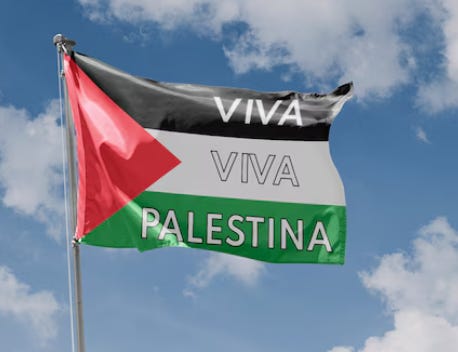
Pablo, Viva Palestina. From the Blind Poet Borges, I see you, Neruda in the night, following a blue moon along the Siuslaw Forest, and those Siletz tribesmen and women sing to the mussels, and the smelt as coho chase the last rays of summer. It’s your new love poem to humanity.
From Borges, Pablo, for you and Gaza:
“A man sets himself the task of portraying the world. Through the years he peoples a space with images of provinces, kingdoms, mountains, bays, ships, islands, fishes, rooms, instruments, stars, horses, and people. Shortly before his death, he discovers that that patient labyrinth of lines traces the image of his face.” from The Garden of Forking Paths.
Palestina ….You say, Pablo: “Love is so short, forgetting is so long.” It is the journey of dreams and nightmares entwined like the night-blooming cereus.
The End