






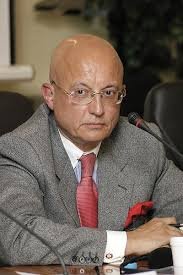
 First published in June 2023, Sergei Karaganov’s [image left] case for a nuclear pre-emptive strike by Russia against a NATO country in Eastern Europe was greeted with almost universal derision or scepticism by establishment scholars. For example, Cimbala and Korb (2023) dismissed his proposals as ‘delusionary musings about walking on the wild side of nuclear first use.’
A small number of Russian commentators were also critical, stating that Karaganov’s views were not the official position in Russia and that in November 2022, ‘the Russian Foreign Ministry explicitly stressed the inadmissibility of the use of nuclear weapons, limiting this possibility to the conditions specified in Russia’s nuclear doctrine’ (Timofeev, 2023).
For my part, while supposing that the 2023 article most likely was an aspect of the to-and-fro of big power posturing, I was disturbed that the prospect of a nuclear strike seemed to be inching its way up the escalation ladder and becoming more explicit and more immediate.
This notable figure was clearly in a state of some alarm at the growing military threats faced by his country. To the point where he was prepared to advocate a Russian limited nuclear strike on the NATO country of Poland, assuming that the US would be ‘mad’ to intervene and would not be willing to trade ‘Boston for Poznan’ (Karaganov, 2023).
However, my fears were allayed somewhat by the fact that while Karaganov was clearly a person of considerable intellect, stature and influence,1 the views that he expressed in the 2023 article were perhaps not as well made as they could have been. They were more like a rallying cry made in a hurry than a coherent logical argument that had been carefully thought through. Words to the effect that ‘we must make Russia great again by finishing the job in Ukraine and getting those aggressive Europeans off our backs’.
Also, notable by its absence was any suggestion that the position he was advocating was widely received at the highest levels of government decision making in Russia, a supposition confirmed by Timofeev (2023, ibid).
I was reminded of this when listening to Karaganov’s latest remarks on the subject, made in an interview with Glenn Diesen in mid-May 2026. Karaganov’s current views about what Russia should do to save itself (and, in the process, the rest of humanity) are in some respects unchanged but in others there has been a significant shift towards beefing up Russia’s nuclear weaponry without advocating its immediate use in Europe (see below).
However, albeit with no substantiating empirical evidence, more alarmingly than when he first published them, he now asserts emphatically (in the Diesen interview) that his current views are supported by most Russian leaders and the Russian people.
I suspect that if this claim is true its better reception in the Kremlin had everything to do with the adjustments Karaganov has made to his 2023 position.
Apart from anything else, this may well have happened because the Kremlin will not want to be seen to be endorsing rash or ill-considered statements that are not in harmony with the Xi-Putin Beijing communique of May 2026 and its measured messages regarding the close and cooperative relations between China and Russia and the desirability of global peace, harmony, and prosperity for all.
So, what, precisely, are those adjustments? In early May 2026, Karaganov published an article entitled ‘How Russia can win the new world war,’ which updates his 2023 position along the lines suggested broadly above and presents a more detailed argument in support of it, as discussed later in this paper.
Of course, as establishment scholars would be quick to point out, none of the above detracts from the possibility that the latest iteration of Karaganov position is simply more sabre rattling or ‘disinformation prompted by Russian government sources that would prefer this messaging to come from a purportedly objective academic source instead of the Kremlin’ (Cimbala & Korb, 2023, ibid).
Nevertheless, as we shall see, the changes are significant and given the high credibility of the source, it would be foolish to dismiss Karaganov’s most recent remarks as merely more clumsy propaganda or ‘delusional’ fearmongering, as Cimbala and Korb (2023 ibid) and others did a few years ago.
Below we therefore discuss briefly Karaganov’s perceptions of the geopolitical backdrop of his concerns; set out the principal features of his 2023 and 2026 remedies; and consider the implications of the latter for the doctrine of Mutually Assured Destruction (MAD).
The Geopolitical Setting2
Karaganov regards the wars currently being conducted, supported or contemplated by the West (the US and its allies) as evidence of ‘horizontal escalation’ that is designed to weaken Russia (and China). The geographic scope of such conflict is being extended to encompass North Africa, the Middle East, South Eurasia, and Southeast Asia. The aim is to disrupt energy and other supply chains and the peaceful development of these regions, particularly by China; and to create economic and political turmoil in the countries affected, that is, conditions that the US can exploit to its advantage politically, militarily, and economically.
Informed commentators like Berletic (2026) and Crooke (2026) strongly endorse this view.
He depicts Russia’s current share of this manufactured turmoil — the West’s proxy war in Ukraine — as an open, ‘bleeding wound’ that has already cost far too many Russian lives.
Under existing geopolitical conditions, whatever form the eventual, and inevitable, Russian victory takes, there will remain in parts of Ukraine ‘an even more embittered ultranationalist population pumped up with weapons’, which is egged on and supported by the West. The conflict, and the significant human and material costs to Russia, will therefore persist indefinitely unless something is done to prevent it.
Drawing on deep wells of ‘centuries-old Russophobia,’ European aggression towards Russia will increase as the desperation and incompetence and authoritarianism of its ruling elites increases in the face of a failing political economy based on unipolarity, imperialism implemented through military aggression and other means, and the desire to maximise profit before all else.
As with the war against Iran, during this period, ‘truce[s] [will be] possible, but peace [will] not.’
Very recent pledges of support and agreements by Germany, Norway, the Netherlands, Belgium, and Spain to invest in Ukraine’s long-range strike capabilities and the supply of thousands of mid-range attack drones targeting Russian battlefield supply lines support this view.
Russians have been particularly incensed by a Ukrainian attack on a student dormitory in an occupied part of eastern Ukraine on 22 May 2026, in which 18 youths were killed and 42 others injured.
These escalations raise the possibility that manufacturing facilities in countries like the UK that supplied the parts for the weapons used will be targeted (Macgregor, 2026).
Signs and threats of retaliation by Russia are already evident in Baltic states like Latvia, which Sachs (2026a) now regards as the most dangerous region in the world. Its attacks against Kiev have intensified greatly. According to Sachs (2026b), ‘Europe and Russia are slipping into open war.’
A cornerstone of Karaganov’s strategy for dealing with Europe and the more general problem of what he sees as an inexorable slide towards World War III, which Western aggression portends and promotes, is the strength of US commitment to Europe or lack of it.
Consistent with Mearsheimer’s widely received notion of offensive realism, and particularly under the Trump administration, Karaganov regards US relations with Europe as increasingly tenuous or brittle. When its interests are at stake, the US will treat allies, NATO, and Europe as expendable. It follows that in peripheral spheres of influence US vassal states like Australia are particularly vulnerable to abandonment in times of crisis.
In the event of a limited nuclear strike by Russia against a European target, in 2023, Karaganov asserted, ‘Only a madman who, above all, hates America, will have the guts to strike back in “defence” of Europeans, thus putting his own country at risk and sacrificing conditional Boston for conditional Poznan.’
He claimed that both the US and Europe ‘know this very well.’
Non-establishment observers like Scott Ritter (2026) are equally convinced that the Trump administration would not ride to Europe’s rescue in the event of a limited nuclear attack on it by Russia.
However, perhaps the most crucial feature of Karaganov’s perception of the geopolitical setting as seen in 2023 was his assumption that in the 75 years since atomic bombs were dropped by the US on Hiroshima and Nagasaki, people in the West have lost their fear of these ‘weapon[s] of Armageddon’. Western elites have become complacent.
In his view, ‘that fear needs to be revived, otherwise humanity is doomed.’
Karaganov’s 2023 and 2026 Remedies
The 2023 Remedy
‘The enemy must know that we are ready to deliver a pre-emptive nuclear strike.’
‘By breaking the West’s will to continue the aggression, we will not only save ourselves and finally free the world from the five-century long Western yoke, but we will also save humanity… we will force them to back down before a global catastrophe occurs.’
In 2023, Karaganov’s remedy for the above was ‘to arouse the instinct for self-preservation that the West has lost and convince it that its attempts to wear Russia out by arming Ukrainians are counterproductive for the West itself.’ This would be achieved by making ‘nuclear deterrence a convincing argument again by lowering the threshold for the use of nuclear weapons…, and by rapidly but prudently moving up the deterrence escalation ladder’ (Karaganov, 2023).
In short, while Karaganov (2023) did not state this explicitly, we can infer from what he did say that the disastrous situation faced by Russia and the world can only be improved if Russia brings the West to its senses by making a limited nuclear strike on a non-nuclear European country like Poland. And if this did not make the Europeans back down, then ‘we will have to hit a bunch of targets in a number of [European] countries in order to bring those who have lost their minds to reason’ (Karaganov, 2023).
‘If they can be used “successfully” [in this way], this will break the nuclear taboo – the idea that they cannot be used under any circumstances and that their use will inevitably lead to a global nuclear Armageddon’ (Karaganov, 2023).
For Karaganov (2023), this action would cut short all European and US support to Ukraine, thereby staunching Russia’s ‘bleeding wound’ and solving the Ukrainian problem.
It would reinstall Russia to its rightful place as a leading world power and civilisation or what Karaganov (2023) grandly calls a ‘civilisation of civilisations.’
And it would save the world from itself: the small catastrophe of a limited nuclear strike would prevent an all-out nuclear conflagration and the resulting extermination of life on earth (the dangerous idea of ‘escalate to de-escalate’).
The 2026 Adjustment3
Karaganov’s most recent policy proposals have clear parallels with the above, but there are also some significant departures. His 2026 policy recommendations can be summarised as follows:
-
Defuse Western aggression by destroying the Kiev regime and liberating parts of Ukraine. Lasting peace and development for Russia and the rest of the world can only be achieved by ‘thwarting the West’s attempt at military-political revenge, with Europe once again at its forefront.’ The solution to this problem is to be found in the destruction of the Kiev regime and the liberation of the southern and eastern parts of Ukraine, which are seen to be ‘vital to Russia’s security.’
-
Increase nuclear deterrence. To help it achieve objective one above, Russia must accelerate its development of missiles and ‘other medium- and strategic-range delivery systems’ such as ‘Burevestnik, Oreshnik, and other hypersonic delivery platforms.’ This rules out any consideration of arms control. However, the joint management of nuclear deterrence and strategic stability may remain useful and even necessary.’
-
Countenance attacks on Western bases and assets in other countries. Russia must be prepared to attack and destroy US and Western European military bases and other assets located in other countries, in much the same way as Iran has done. He sees this high level of dependence on such bases and assets by the West as a weakness that should be exploited.
-
Show willing to make such strikes pre–emptively and to decapitate. Targets should include those mentioned above and the bunkers that shelter Western elites, which will require the development of weapons designed to penetrate reinforced underground structures.
-
Give elites in the West something to really fear. Elite Russophobia in the West is a sham because they do not really believe that Russia will use nuclear weapons. ‘This illusion must be broken. They must be made to understand that continued escalation carries existential risks.’ This will also overcome ‘strategic complacency’ or the belief that ‘war a large scale is impossible.’
-
Make more explicit what will provoke a nuclear attack by Russia. Russia’s nuclear doctrine should state unambiguously that ‘in the event of aggression by a coalition possessing greater economic, demographic, and technological potential, the use of nuclear weapons may become unavoidable. This must be framed as a last resort, but a real one.’ This can be reinforced by the resumption of nuclear testing.
-
Escalate rationally and under control. Such escalation should prioritise ‘conventional strikes against command centres and strategic infrastructure.’ ‘Further steps’ should only be considered be in response to provocation.
-
Nuclear deterrence must be used to counter drones and other ‘new forms of warfare.’
-
Military command structures must reflect the above. Special attention should be given to Europe in this regard.
-
‘… reconsider the notion that nuclear war can have no winners.’
-
Strengthen cooperation with ‘key partners’, especially China. To ‘prevent further escalation and maintain global balance,’ the possibility of a ‘temporary defensive framework’ with China should also be considered.
-
Help to ‘stabilize other regions, including the Middle East, through new security arrangements involving major powers.’
Conclusion
For those of us who, for reasons like those discussed above, have been holding their breaths since June 2023, we can now afford to exhale a little. Karaganov’s (2026) position is still a cause for concern because it signals Russia’s growing alarm at Western aggression and its determination not to be bullied.
But gone is the rude shock of making a limited nuclear strike on, say, Poznan right away (in the belief that it will not be traded for Boston) and attacking a ‘bunch of other countries’ if flattening Poznan didn’t work.
In their place are some unsurprising recommendations regarding the targeting of Western overseas assets and elites (following the US-Israeli decapitation playbook in Iran and elsewhere) and the willingness for Russia to be prepared to strike pre-emptively. Unsurprising because they are what one might expect from anyone who had been paying attention to the war against Iran.
Equally unsurprising is the desire to win the war in Ukraine convincingly and soon, the strengthening of ties with China, the development of ‘adapted’ military command structures, and the need to be able to counter drones and other new forms of warfare.
On the positive side, measures that could be taken to reduce the chances of nuclear war include increased specificity about what will trigger a nuclear response, the insistence on rational or measured and controlled escalation from conventional to nuclear weapons, and the interest in ‘stabilising’ the Middle East (and other regions), possibly in collaboration with unspecified ‘major powers.’
In their place, however, is the worrying statement about the need to reconsider the notion that nuclear war can have no winners, the abandonment of arms control, and the resumption of nuclear testing.
With the latter intentions as important caveats, in essence, the 2026 Karaganov nuclear policy adjustment puts global big power rivalry firmly back in the MAD bin, albeit with embellished arsenals and some important and worrying departures from the traditional logic of deterrence, which we might now describe as follows (paraphrasing Kolbin, 2026):
‘Nuclear weapons are so destructive that their mere existence manages still to imposes a sufficient – though increasingly precarious – degree of discipline and responsibility on those who possess them to prevent all-out war. However, escalation is not as tightly managed as it should be. Increasingly it seems, red lines are not respected, and arms control is treated as a conditional concession rather than a shared survival mechanism.’
This suggests that, like the strategies and weapons shown up by the war against Iran to be dinosaurs from another age, the blunderbuss of nuclear weaponry might be losing some of its intimidatory thunder? The logic of nuclear deterrence has not vanished completely, but is it, as Kolbin (2026) suggests, ‘slowly and decisively losing its force’?
Evidence to support such a conclusion includes:
‘For almost four years, Russia—the world’s largest nuclear power—has been subjected to missile strikes carried out with systems supplied by several other nuclear-armed states. The United Kingdom now openly speaks of developing new tactical ballistic missiles for Kyiv and of placing “leading-edge weapons” directly into the hands of Ukrainians. Russia itself employs nuclear-capable intermediate-range ballistic Oreshnik missiles as if they were any other conventional weapon system for punishing Ukrainian infrastructure’ (Kolbin, 2026, ibid).
Accordingly, for Kolbin (2026, ibid), nuclear deterrence is dying. Nuclear weapons are
‘… catastrophic but unusable. They inspire fear, but not necessarily restraint. They no longer prevent adversaries from striking directly at a nuclear-armed state’s territory, infrastructure, or proxies. Instead, they sit in the background while conflicts are fought with tools that are faster, cheaper, and politically easier to employ.’
Thus far, the use of nuclear weapons has been forestalled successfully by the certainty of MAD, but such deterrence is being put under mounting pressure and has proved unhelpful to preventing the massive death and destruction that can be achieved by other means (with AI lurking in the background to exacerbate this).
The limits of Russian tolerance in the Ukraine war are being tested severely, as are Iran’s.
The brinkmanship in the question of how much of a nuisance do you have to be, how much drone damage or carpet bombing do you have to do to qualify for a nuclear response remains. Answers are likely to be highly variable and unpredictable and dependent on individual and geopolitical factors that cannot be easily controlled.
The experience of the wars in Ukraine and Iran suggests that the pain thresholds can be quite high, but that is clearly no guide to how, say, the US or the UK or Germany would react to similar provocation.
Parts of Karaganov’s (2026) position attempt to address this question by upping the ante on weapons and targets, specifying red lines more clearly, and proclaiming that ‘this time we are really serious.’ But is this just more of the same, with lethal additions? Most of all the idea that all-out nuclear war could have a winner.
We are left with heightened uncertainties and precarious international relations that rely on an ailing MAD doctrine to keep the lid on a pot that is constantly on the boil with temperatures rising.
ENDNOTES:
1 Sergei Karaganov is a distinguished professor at the National Research University–Higher School of Economics, Honorary Chairman of the Council on Foreign and Defence policy, and a former adviser to Boris Yeltsin and Vladimir Putin.
2 All unacknowledged quotes in this section are from Karaganov (2023, ibid).
3 All unacknowledged quotes are from Karaganov (2026, ibid).